Suchergebnisse
"Eva Buddeberg"
Titel: Is There Moral Progress?
Autor: Eva Buddeberg
Seite: 195-203
Post- and decolonial theory have contested the idea of historical progress as a Eurocentric, hegemonic, or neocolonialist misconception. Does this imply that we should give up any idea of moral progress? This paper critically examines Allen Buchanan’s and Russell Powell’s book The Evolution of Moral Progress and their claim that there is still a need for a theory of moral progress. For Buchanan and Powell, such theory should allow and guide a better understanding of what moral progress consists of. Even though they do not claim to already provide us with such a comprehensive theory of moral progress they aim towork outwhether and how certain types of moral progress are possible and assess their limits. In doing so they mainly focus on improvements in terms of social participation as an uncontroversial type of moral progress. In the following, I will first discuss the characteristics of the authors’ notion of progress and then raise some critical concerns about the example they have chosen of the history of human rights as a history of progress and, particularly, about the history of the rights of people with disabilities.
Titel: Shared Responsibility for the Development and Use of Artificial Intelligence
Autor: Eva Buddeberg
Seite: 5-25
Philosophical literature generally highlights three different aspects or dimensions of responsibility: 1. the attribution of authorship of actions and the liability of the actor for these actions; 2. the attribution of a duty of care for certain tasks or areas of responsibility; and finally 3. the obligation to justify one’s own behaviour and actions with good reasons. The discussion about the development and the use of artificial intelligence currently focuses on the first and, to some extent, the third aspect. However, the rapid pace of development and the now omnipresent use of AI also require ongoing critical examination and reflection on the normative framework. Responsibility must therefore be understood more broadly: with regard to the development and use of artificial intelligence, we bear a discursive shared responsibility that involves examining the development and use of AI systems against the yardstick of justice, as well as the normative framework itself that guides us in the development and use of AI systems.
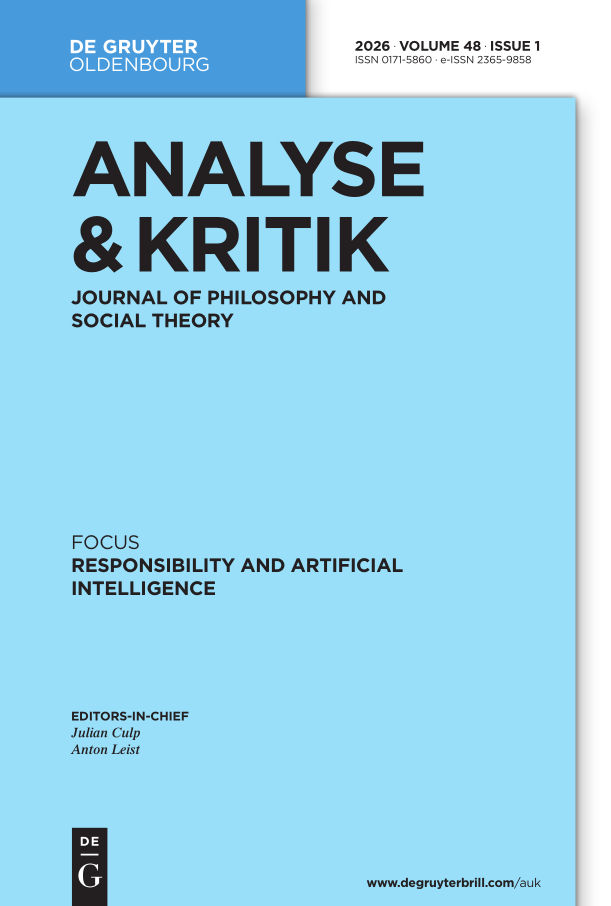
Focus: Responsibility and Artificial Intelligence
2026 (48) Heft 1
Editorial
As is evident everywhere, research into artificial intelligence has advanced by leaps and bounds in recent years, leading to a rapid increase in its use across almost all areas of life. As early as 2018, the German government of the time set out a ‘Master Plan for Artificial Intelligence’ in its coalition agreement, and the current government plans, as announced in a recently published strategy paper, to quadruple Germany’s AI capacity by 2030. Artificial intelligence is regarded as a key ...